
Match Dickens County Supervision Records
A reliable check uses the least personal data needed to identify the right person. Full name, aliases, birth date, TDCJ or SID number, and the sentencing court can separate similar results. Record the date of each search because a supervision status can change. If a phone answer is used, note the office and the exact terms spoken.
Keep the decision, physical release, supervision start, current status, and discharge as separate events. When TDCJ, the court, and the local department show different dates, do not pick one by guess. Ask each office which part of the history its record covers and preserve the conflict until the originating agencies resolve it.
Dickens County Parole and Probation
Parole is a discretionary release from confinement in the Texas Department of Criminal Justice, or TDCJ, while the person serves the rest of a sentence under state supervision. Mandatory supervision is a separate release method created by law. It also places a person outside prison under rules, but eligibility and release are not automatic for all cases. Discharge usually means the applicable sentence has ended. Each term marks a different point in the custody record.
Probation, called community supervision in Texas law, begins with a court order. Dickens County adult probation is administered by the 110th Judicial District Community Supervision and Corrections Department, which serves Briscoe, Dickens, Floyd, and Motley counties. A probationer may never have entered TDCJ. The sentencing judgment and docket identify the court order, while the local department administers the conditions. There is no statewide public person-by-person adult probation search.
| Question | Parole | Probation |
|---|---|---|
| Who orders it? | Texas parole authorities | Sentencing court |
| Who supervises it? | TDCJ Parole Division | 110th Judicial District CSCD |
| Best proof | IVSS, status line, or TDCJ record | Judgment, docket, and CSCD confirmation |
| Does it prove jail exit time? | No | No |
Verify Dickens County Parole Status
Start with the custody type. If TDCJ confinement is plausible, search TDCJ IVSS by name, SID, current TDCJ number, or prior TDCJ number. Open the correct record and read the status as written. The ordinary TDCJ inmate locator includes only people who are currently incarcerated, so a missing name never proves parole or discharge. IVSS, the Parole Status Line, and agency records are stronger routes for someone outside prison.
- Match the person with a full name and a reliable agency number or birth date.
- Review TDCJ IVSS for prison, parole, mandatory-supervision, or discharge wording.
- Call the Parole Status Line at 844-512-0461 when the online status is unclear.
- Ask TDCJ for the decision, start date, release certificate, and discharge status when exact proof is needed.
- Confirm physical release through Classification and Records if only a favorable Board code appears.
The Board can approve release before all processing is complete. A program, residence plan, detainer, new hold, or certificate audit may keep the person confined. The state record should distinguish the decision from the actual release event.
Verify Dickens County Probation
For probation, use the Dickens County and District Clerk and its linked online records search. Look for the judgment, sentence, docket events, modifications, and any order that places the person on community supervision. The combined clerk handles both county and district records, though the type of case controls which side of the office owns the file. A certified judgment is the best starting record when the terms matter.
Next, contact the 110th Judicial District CSCD through the county's Adult Probation page. Privacy and identity checks may limit what staff can say about a named person. Ask which office supervises the case and what public record can confirm status. Do not treat a court docket alone as proof of present compliance or of the time a person left jail.
512 Montgomery
Dickens, TX 79229
Phone: 806-983-4915
Fax: 806-983-4920
Email: lltrevino@co.floyd.tx.us
Published hours: not stated; confirm before visiting.
Dickens County Parole Review
Texas does not hold a public formal hearing for each initial parole review. The Board review process uses a case summary and a three-member panel. Public Board business meetings are not calendars for individual cases. This distinction prevents a meeting date from being mistaken for a person's decision or release date.
Decision codes also need care. A favorable FI code may require a program, an approved plan, or release on a stated condition. RMS concerns release to mandatory supervision. NR sets a later review, while other codes may require the person to serve more of the sentence. Current definitions should be checked in the official Board material. Final decisions may be public, but protected source material can remain confidential.
The manifest image below comes from the official Board decision-reasons page.
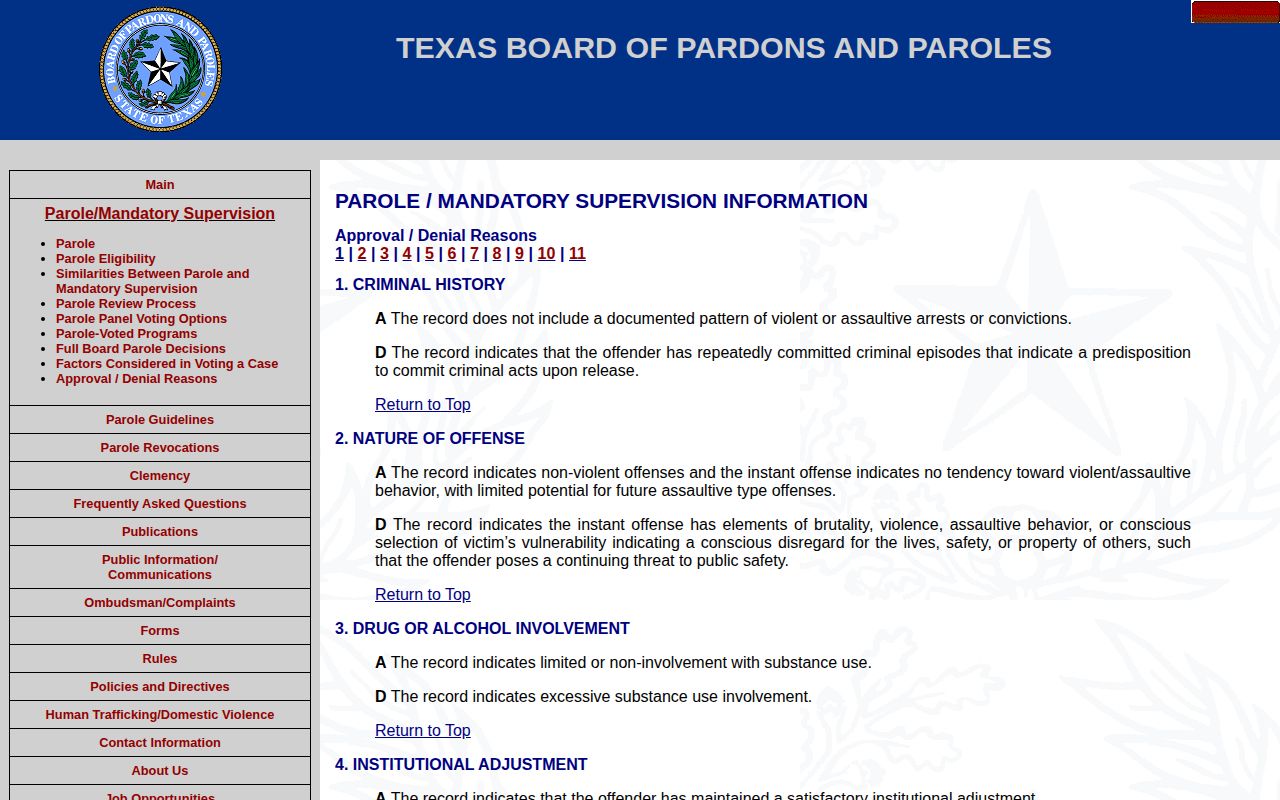
It helps decode a result, but the code still must be paired with the release and supervision record.
Dickens County Supervision Violations
A parole warrant or alleged violation may lead to detention and a revocation process. That later event does not erase the earlier release. It changes current custody or supervision status. Revocation proceedings are different from initial parole review and may result in continued supervision, changed conditions, an intermediate sanction, or return to custody.
An absconder is a person alleged to have stopped reporting or otherwise left supervision without approval. The Texas sex-offender absconder information is a narrow registry tool, not a list of every parolee or probationer who missed contact. Confirm a warrant through the supervising agency and the appropriate court or law-enforcement record. Automated notification can help track changes, but it is not a substitute for the originating agency.
- Parole
- Conditional release from TDCJ confinement while a sentence continues.
- Probation
- Court-ordered community supervision, which need not follow prison.
- Mandatory supervision
- A separate statutory form of supervised release for eligible cases.
- Absconder
- A person alleged to have left supervision or stopped required contact.
- Discharge
- The end of the applicable sentence or supervision term.
Correct Dickens County Release Calculations
A disputed TDCJ time or release calculation belongs with Classification and Records, not the records-retention office. Call 936-437-6231 or email classify@tdcj.texas.gov. Ask staff to identify the projected date, any scheduled date, the actual release event, and any hold or commitment discrepancy. If a formal record is needed, use the TDCJ public-information route.
TDCJ Records Management publishes retention schedules, but it expressly is not the office for a person's release question. Keeping those roles separate saves time. A schedule tells the agency how long a record series is held. Classification and Records handles sentence time, transfers, and releases. The Dickens County released-inmate search and release-record path explains how to pair the state response with the local jail or court record.
Note: Ask whether “released” means community release, parole, discharge, or transfer to another custodian.
Dickens County Supervision Discharge
Supervision ends only when the controlling authority records that result. For parole or mandatory supervision, request the TDCJ discharge or maximum-expiration status. For probation, use the sentencing court's discharge order or final docket entry and confirm it with the CSCD when needed. A completed jail term is not always the end of all court duties, and a prison release can begin rather than end parole supervision.
Texas Government Code Chapter 508 governs parole and mandatory supervision. Eligibility and exclusions depend on the offense, sentence, and governing law. There is no sound shortcut based on a single percentage. The same care applies to probation: the judgment and later orders control, not a broad assumption about how long local supervision should last.
Keep the proof chain clear: decision, physical release, supervision start, current status, then discharge. Each record answers a separate question. When records conflict, report the conflict and ask the offices that created them to reconcile it.